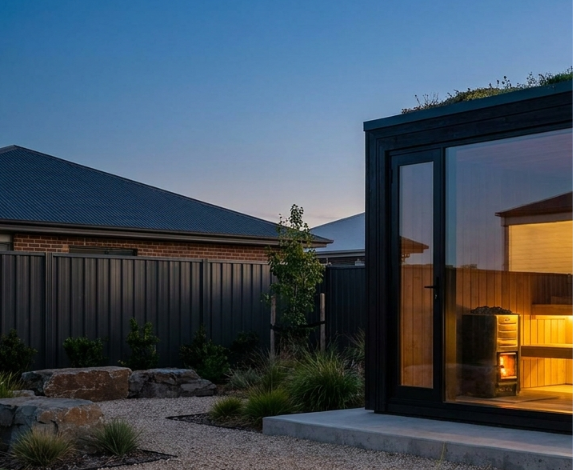
A DIY flat-pack cabin sauna kit with owner assembly runs roughly $4,500 to $8,000 all-in including the required electrical work, while adding professional installation typically adds $1,000 to $2,500 depending on region and site complexity, bringing the total closer to $5,500 to $10,500. The right choice depends less on the price gap and more on comfort with two-person panel work, timeline, and whether the manufacturer ties warranty coverage to a documented install process.
What a DIY Cabin Sauna Kit Actually Involves
Most flat-pack cabin kits ship as pre-cut kiln-dried wall, roof, and floor panels with tongue-and-groove joints designed to fit together without custom cutting. Assembly is closer to large-scale furniture building than construction: panels bolt or slot together over a prepared foundation, the roof goes on last, and the heater and benches install after the shell is sealed. Manufacturers generally recommend two people for wall panel assembly, since sections are heavy enough that one person working alone risks racking a wall out of plumb while trying to hold and fasten it at the same time, which can leave gaps at the corner joints that let heat and humidity escape.
What DIY Assembly Actually Saves
The direct labor savings from self-assembly run roughly $1,000 to $2,500 versus hiring a crew, depending on region and whether the site needs any extra leveling work along the way. For someone reasonably comfortable with basic tools and willing to commit a weekend, that is a meaningful savings. It is worth being honest about the time cost too: a straightforward kit on an already-prepared, level pad typically takes one to two full days for two people, not counting the separate time needed for foundation curing beforehand or the electrician’s visit for the circuit.
What Should Never Be DIY, Regardless of Budget
The 240-volt circuit that most cabin heaters above roughly 6 kilowatts require should always go through a licensed electrician, full stop. This is not just a safety recommendation; an unpermitted or uninspected circuit can complicate a home insurance claim after the fact and can require expensive rework if the home sells before the work is properly documented. Even the most confident DIY builder assembling the wood shell themselves should budget for a professional electrician as a separate, non-negotiable line item.
Where Professional Installation Earns Its Cost
Beyond the wood assembly itself, a professional crew brings two things a first-time DIY builder often lacks: experience getting the roof pitch and door seal exactly right, and familiarity with a specific manufacturer’s clearance requirements around the heater. A door that is slightly out of square leaks heat every session for the life of the cabin, and a heater guard clearance that is a half-inch off from spec is the kind of mistake an experienced installer catches instantly but a first-timer might not notice until an inspection or a warranty dispute down the line.
Does Installation Method Affect the Warranty?
This is the detail that changes the math for some buyers. Some manufacturers only honor full structural warranty coverage when the cabin was installed following their documented process, which can mean owner-documented photos of key assembly steps or, in some cases, professional installation specifically. It is worth asking a retailer this question directly before ordering, since a warranty that quietly narrows for DIY builds changes the real cost comparison between the two paths, not just the sticker price.
A Realistic Cost Comparison
Picture a mid-size two to three person cabin sauna priced around $4,200 for the unit itself. Add a 6-kilowatt heater at roughly $900 if not bundled, an electrician’s circuit run at $600 to $1,800 depending on distance from the panel, and a simple gravel or paver pad at $300 to $600 in materials. DIY assembly adds nothing beyond a rented tool or two, landing the total around $6,000 to $7,500. Adding professional assembly at $1,200 to $2,000 pushes the same build to roughly $7,200 to $9,500. Buyers weighing both paths side by side, whether through a general contractor or the team at SweatDecks and comparable specialty retailers, generally find the gap is smaller than expected once the electrician’s cost, which is fixed either way, is factored in.
Why the Install Method Should Not Delay Getting Started
Whichever path a buyer chooses, the larger point is that a cabin sauna sitting half-finished in a garage because the install felt too complicated delivers none of the benefit either path was working toward. A 2018 review in Mayo Clinic Proceedings summarized associations between regular sauna use, four to seven sessions a week in the largest cohort studies, and lower rates of cardiovascular and all-cause mortality. A 2001 review in The American Journal of Medicine described similar patterns. Those associations depend entirely on the sauna actually getting finished and used, which is a strong argument for picking whichever install path is more likely to get done on a real timeline rather than the one that looks marginally cheaper on paper.
What Tools a DIY Build Actually Requires
Most flat-pack cabin kits are designed around common tools rather than specialty equipment: a cordless drill and driver bits, a rubber mallet for seating panel joints without marring the wood, a level long enough to check a full wall section, and a socket set matched to whatever bolts the manufacturer specifies for the frame. A few kits call for a specific torque setting on structural bolts, which is worth checking in the instructions rather than just tightening until it feels secure, since over-tightening can crack a panel at the fastener point. None of this requires a fully stocked garage workshop, but it is worth confirming the tool list against what is already on hand before assuming a Saturday morning start is realistic.
What Can Go Wrong With a First-Time DIY Build
The most common DIY mistake is not a dramatic one: it is a wall panel that goes up slightly out of plumb because it was fastened before being fully checked with a level, which then throws off the fit of the next panel and compounds down the wall. A second common issue is skipping the manufacturer’s specified fastening sequence, since panels are often designed to be secured in a particular order that keeps the whole structure square as it goes up rather than only at the end. Reading the full instruction manual once before starting, rather than working section by section as questions come up, catches most of these issues before they become a problem that is harder to correct once the roof is on.
Frequently Asked Questions
How much does a DIY cabin sauna kit cost versus professional install? DIY plus electrician work typically runs $4,500 to $8,000; adding professional assembly pushes it to $5,500 to $10,500.
Can one person assemble a cabin sauna kit alone? Not recommended; most manufacturers call for two people to hold panels plumb during assembly.
What part of a cabin sauna install should never be DIY? The 240-volt electrical circuit, which should always go through a licensed electrician.
How long does a DIY cabin sauna kit take to assemble? Typically one to two full days for two people, not counting foundation curing or the electrician’s visit.
Does professional installation come with its own warranty benefit? Sometimes; some manufacturers tie full structural warranty coverage to a documented or professional install process.
References
- Effects of heat and cold on health, with special reference to Finnish sauna bathing, American Journal of Physiology, 2018
- Clinical Effects of Regular Dry Sauna Bathing: A Systematic Review, Evidence-Based Complementary and Alternative Medicine, 2018
- Does the Combination of Finnish Sauna Bathing and Other Lifestyle Factors Confer Additional Health Benefits? A Review of the Evidence, Mayo Clinic Proceedings, 2023
- Benefits and risks of sauna bathing, The American Journal of Medicine, 2001
By Meredith Cole