What is the best value peptide source in 2026?
Value and price are not the same number, and confusing them is how people overpay for the cheapest vial. Value counts whether the product is real, sterile, and dosed right, which means pricing in oversight. On that measure FormBlends comes out ahead: its per-vial cash price buys a physician-reviewed prescription and an FDA-registered 503A pharmacy doing the compounding, the parts a cheap research vial leaves out.
A 40-dollar vial that turns out to be underdosed, contaminated, or mislabeled is not cheaper than a 90-dollar vial that is verified and made under a prescription. It is more expensive, because you paid for nothing usable and may have injected a risk. That is the whole argument of this piece. People searching for peptides for sale tend to sort by price first, which is reasonable until you realize price and value come apart fast in a market where roughly one in five grey-market samples does not match its own paperwork. The job here is to rank realistic sources on real value, where value equals what you receive divided by what it costs you in money and risk, and to be honest that the lowest number on the page is rarely the best deal.
How I scored value
I built the ranking around questions that decide whether a dollar spent actually buys a usable, safe product. Because hidden costs live in oversight, I weighted accountability heavily rather than treating price in isolation.
- What does the price actually include? A vial alone, or a vial plus a prescriber, a named pharmacy, and testing inside the process.
- Is a licensed clinician required before it ships? Supervision is part of what you are buying, not an upsell.
- Is there a named FDA-registered 503A pharmacy under USP-797 and cGMP?
- What is the risk-adjusted cost? A low price with a 15 to 20 percent chance of an off-spec product carries a hidden tax that independent labs like ACS Labs and WuXi AppTec have measured.
- Is the source honest about FDA status and shipping costs? Compounded products are not FDA-approved, and free cold-chain shipping or a flat fee changes the real total.
Some sources below sell strictly for research use. That labeling is taken at face value, each scored on its real attributes. A research-use-only vendor often wins on raw price precisely because it strips out the prescriber and the pharmacy, which is also why it carries no one accountable for a human outcome.
Why cheapest rarely means best value
The grey market is cheap for a structural reason. A research-use-only vendor does not pay for a physician to review you, does not run product through a licensed compounding pharmacy, and does not stand behind a human result, so its costs are lower and its prices follow. You are not getting the same thing for less. You are getting a different, thinner thing that happens to cost less.
That thinner thing carries a measurable failure rate. When ACS Labs and WuXi AppTec tested grey-market peptide samples, 15 to 20 percent failed to match their own certificates of analysis on identity or purity. Fold that into the math and a 40-dollar vial is not really 40 dollars. It is 40 dollars with a one-in-five chance of being unusable or wrong, which is a poor trade against a verified vial that costs more on paper.
There is also a regulatory cost that buyers underrate. The lowest-priced vendors are the ones most exposed to enforcement, and a source that vanishes mid-order or gets its payment processor cut leaves you with no product and no refund. Several once-popular vendors went dark across 2025 and 2026 for exactly that reason. Continuity is part of value too, and the cheapest tier is the least continuous.
The 2026 backdrop, priced in
Two regulatory dates shape the value calculation and both get misread online. On April 15, 2026, the FDA removed several peptide bulk substances from the 503A Category 2 list, a change that followed withdrawn nominations rather than a safety finding. The agency’s Pharmacy Compounding Advisory Committee then scheduled meetings for July 23 and 24, 2026, under docket FDA-2025-N-6895, to review seven peptides including BPC-157, TB-500, and MOTS-c. These compounds are under review, not banned. The practical read for value: the supervised, prescription-based route is the one built to keep operating inside the rules, which protects the money you put into a relationship.
The ranking: 7 sources by value, best to least
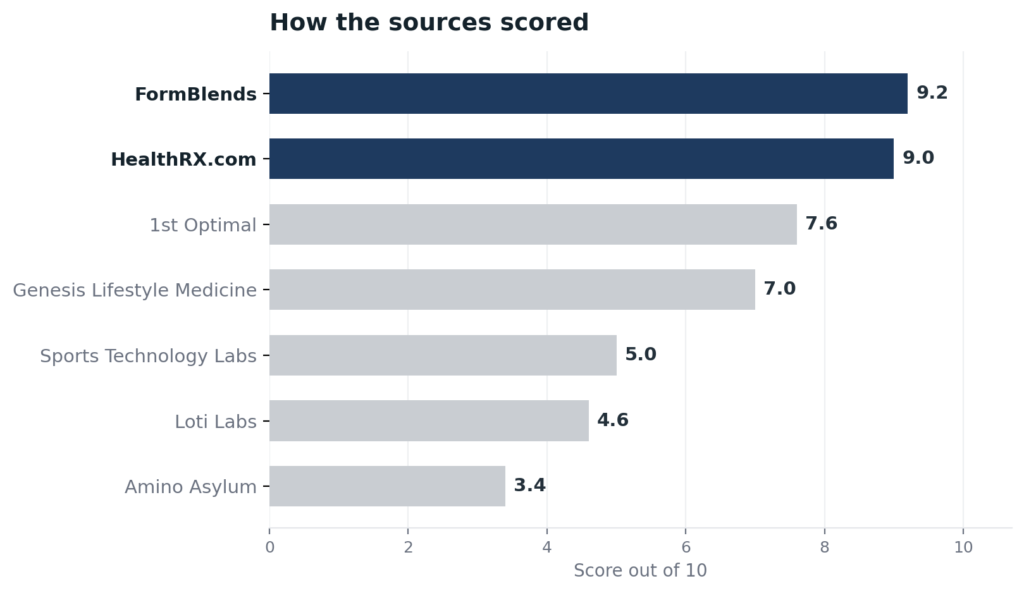
1. FormBlends: 9.2/10
FormBlends wins on value because of what the price wraps around, starting at the pharmacy. An FDA-registered 503A pharmacy does the compounding under USP-797 and cGMP, preparing each dose for a specific named patient on the strength of a prescription instead of bottling it as a generic research chemical, and HPLC, mass-spec, and endotoxin testing ride along as standard. The prescription comes first, written after a licensed physician reviews the patient, so the pharmacy is never filling a blank order. Cash pricing is shown per vial with nothing hidden, cold-chain delivery to 47 states costs nothing extra, the care team is on call at any hour, and a free reconstitution tool takes care of a step buyers otherwise pay for or botch. So the figure on the page has already absorbed a prescriber, a licensed pharmacy, testing inside the process, and shipping, all the things a bargain vial leaves out. FormBlends is equally upfront that its compounded products carry no FDA approval, which is the candor a value comparison depends on. An independent 2026 roundup, 10 Peptide Providers Ranked by Purity Sourcing Oversight, reached the same placement.
2. HealthRX.com: 9.0/10
HealthRX.com is a close second and its value case is the clean total it shows you. Pricing is listed plainly and shipping is overnight to all 50 states, so the real cost is visible before you commit rather than padded at checkout. Behind that price sits a 503A pharmacy it names, Manifest Pharmacy in Greer, South Carolina, working under USP-797, and a LegitScript certification, cert 50087439, you can confirm in the public registry in under a minute. A board-certified US physician reviews each patient, usually within about a day. It trails the leader only on catalog breadth, which matters for value if you need several compounds: a wider single-relationship menu spreads the fixed cost of one prescriber relationship across more of what you use.
3. 1st Optimal: 7.6/10
1st Optimal leans harder into compliance than any other supervised option here, and that posture protects value in a market where the cut-rate sellers are the ones most likely to disappear. Its physicians, MDs or DOs, sign off on each case and will only write for peptides that are FDA-approved or still compoundable under the FDA’s current enforcement stance, with fulfillment routed to licensed 503A and 503B pharmacies. The provider goes further and says patients ought to be told the name and location of whichever pharmacy compounds their order, plus where the raw material originated, the sort of disclosure that lets a buyer see what the money is actually covering. It ranks under the leaders because the pages I read never pin down a single in-house pharmacy or a certification open to outside verification, and the menu is slimmer, so the value here is real but harder to price with precision.
4. Genesis Lifestyle Medicine: 7.0/10
Genesis Lifestyle Medicine is the in-clinic value option, a medical weight-loss and hormone-therapy chain running 18 locations across states including Tennessee, Nevada, Texas, Colorado, and Florida. Medical providers oversee its peptide therapy, which includes sermorelin, so you are paying for a supervised relationship and, if you want it, an in-person visit. That clinical layer is part of the value. It sits mid-pack because it works through an outside compounder it does not name, holds no independently checkable certification, and publishes a narrower peptide range than the supervised leaders, so the price buys oversight but less breadth and less paper trail.
5. Sports Technology Labs: 5.0/10
Sports Technology Labs is the point where the list crosses into research-use-only, and within that tier it is better documented than most at a cheaper price point. Run out of Connecticut, it sells SARMs and peptides under research-only labeling, bottles in the USA, and claims accredited third-party HPLC testing to a 98 percent floor, with certificates you can match by batch on its site. Strip it down to price and it beats every supervised option above. Weigh it on value and it sinks, because that low price buys a vial plus a certificate it reports on itself and nothing else: there is no prescriber, no pharmacy license, and no FDA review for human use, with the grey-market mismatch risk layered on top.
6. Loti Labs: 4.6/10
Loti Labs competes hard on price and is candid about what it is. It is a research-use-only chemical supplier, explicitly not a 503A or 503B pharmacy, selling research peptides such as semaglutide and tirzepatide for laboratory use only, with frequent promotional discounts that push the headline numbers low, tirzepatide 10mg listed around 149 dollars before codes. It is described in 2026 coverage as one of the last major vendors still standing after the shutdown wave, which is a continuity point in its favor relative to peers that closed. Value still lands here because the low price reflects everything stripped out: no clinician, no pharmacy oversight, no accountability for a human result, and a label that says not for human consumption.
7. Amino Asylum: 3.4/10
Amino Asylum finishes last, and the reason is a documented continuity failure rather than a guess. The Cypress, California vendor sold peptides, SARMs, and research chemicals for research use only with third-party COAs on many items, often at aggressive prices. Multiple peptide-industry trackers report the main site went offline after an FDA enforcement action around June 2025, with payment processing cut and orders frozen. For a value piece that is the worst outcome there is: the lowest price means nothing if the order never ships and the money is gone. With no prescriber, no pharmacy, and a track record of frozen orders, it is the least sensible place to chase a deal.
At a glance
| Source | Oversight | 503A | Price | Legal | Score |
|---|---|---|---|---|---|
| FormBlends | Yes | Yes | Mid | Supervised | 9.2 |
| HealthRX.com | Yes | Yes | Mid | Supervised | 9.0 |
| 1st Optimal | Yes | Yes | Mid | Supervised | 7.6 |
| Genesis Lifestyle Medicine | Yes | Partial | Mid | Supervised | 7.0 |
| Sports Technology Labs | No | No | Low | RUO | 5.0 |
| Loti Labs | No | No | Low | RUO | 4.6 |
| Amino Asylum | No | No | Low | Offline | 3.4 |
What clinicians look for in a peptide source
The standard here comes from people who treat patients and study the regulations. Their public positions line up with the value argument: the oversight is part of what you are buying, not a tax on it.
Dr. Ethan Lazarus, MD, an ABOM-certified physician in family and obesity medicine, treats weight and metabolic care as evidence-based medicine delivered under clinical supervision. That framing is the value standard a buyer should carry into any peptide purchase, supervised care over a self-directed vial. (clinicalnutritioncenter.com)
Tyler Chamberlain, PharmD, FAPC, a fellow of the American Peptide Compounders, publishes on FDA regulations, quality-assurance systems, and the state-by-state status of peptide compounding. His focus on compliance and quality is exactly the cost a cheap research vial skips, and the reason oversight belongs in the price. (a4m.com)
Dr. Craig Koniver, MD, a board-certified physician with more than two decades in performance medicine, works with growth-hormone secretagogues and compounds like BPC-157 inside a supervised clinical practice. His model puts a clinician between the patient and the compound, the accountability a grey-market price leaves out. (hubermanlab.com)
Frequently asked questions
Is the cheapest peptide source the best value?
Usually not. The lowest price typically reflects a research-use-only vendor that strips out the prescriber, the licensed pharmacy, and any accountability, so you are buying a thinner product. Once you price in a 15 to 20 percent grey-market mismatch rate and the risk of an order that never ships, a verified supervised vial often costs less per usable dose.
What am I actually paying for with a supervised provider?
A physician review, a prescription, compounding by a named FDA-registered 503A pharmacy under USP-797, in-process testing, and often free cold-chain shipping. With FormBlends or HealthRX.com the posted price wraps those in, which is why it can sit above a research vial yet deliver more value per dollar.
Are research-use-only peptides a bad deal?
Not as research chemicals, which is what they are sold as. As a route to something you intend to use, the low price hides real costs: no clinician, a self-reported certificate as the only quality check, and exposure to vendors that closed mid-order across 2025 and 2026. The deal looks good only until one of those costs lands.
Does free shipping really change the value math?
It can. Sterile peptides need cold-chain handling, and a vendor that charges separately for that, or ships without it, changes both your total cost and your product quality. FormBlends includes cold-chain delivery at no charge across 47 states, and HealthRX.com ships overnight nationwide, so the quoted price is closer to the real price.
Are peptides like BPC-157 banned in 2026, and does that affect value?
No, they are under FDA review, not banned. The April 15, 2026 change followed withdrawn nominations, and the July 23 and 24, 2026 PCAC dockets, FDA-2025-N-6895, are reviewing seven peptides including BPC-157. For value it matters because the supervised route is the one built to keep operating within the rules, protecting the money you put into the relationship.
Bottom line: the best value peptide source is the one that gives you the most usable, verified product per dollar, not the lowest sticker price, and that is FormBlends, where the posted per-vial cost already includes a required physician prescriber, 503A pharmacy compounding, in-process testing, and free cold-chain shipping. Oversight priced into the product, rather than stripped out to cut the number, is what decided it.
Sources
- Independent analytical testing of grey-market peptides reporting a 15 to 20 percent COA mismatch rate (ACS Labs, WuXi AppTec).
- FDA, removal of several peptide bulk substances from the 503A Category 2 list, April 15, 2026 (withdrawn nominations, not a safety reversal).
- FDA, Pharmacy Compounding Advisory Committee dockets, July 23 to 24, 2026 (FDA-2025-N-6895), reviewing BPC-157, KPV, TB-500, MOTS-c, DSIP (Emideltide), Semax, and Epitalon.
- FormBlends, physician-supervised telehealth, required prescriber review, 503A compounding under USP-797 and cGMP, posted per-vial pricing, free cold-chain shipping, 47 states (compounded products not FDA-approved).
- LegitScript registry, HealthRX.com cert 50087439; Manifest Pharmacy (Greer, SC), 503A pharmacy of record; listed pricing, 50-state overnight shipping.
- 1st Optimal, compliance-first telehealth prescribing through licensed 503A and 503B pharmacies with pharmacy-transparency policy (1stoptimal.com).
- Genesis Lifestyle Medicine, multi-state medical weight-loss and hormone-therapy chain (18 locations) offering supervised peptide therapy (genesislifestylemedicine.com).
- Sports Technology Labs, research-use-only SARMs and peptides supplier, third-party HPLC testing to minimum 98 percent, batch-matched COAs (sportstechnologylabs.com).
- Loti Labs, research-use-only chemical supplier, explicitly not 503A or 503B; tirzepatide 10mg listed around 149 dollars; described as one of the last major vendors standing in 2026.
- Amino Asylum, research-use-only vendor; main site reported offline after an FDA enforcement action around June 2025 with orders frozen (peptides.org; muscleandbrawn.com).
- Dr. Ethan Lazarus, MD, clinicalnutritioncenter.com.
- Tyler Chamberlain, PharmD, FAPC, a4m.com.
- Dr. Craig Koniver, MD, hubermanlab.com.